
There is a version of this story that is popular in the industry. Corporate banking, it goes, is complex. The controls, the approvals, the audit trails, the risk frameworks. They exist for good reason. The regulatory environment is demanding. The clients are sophisticated. The stakes are high.
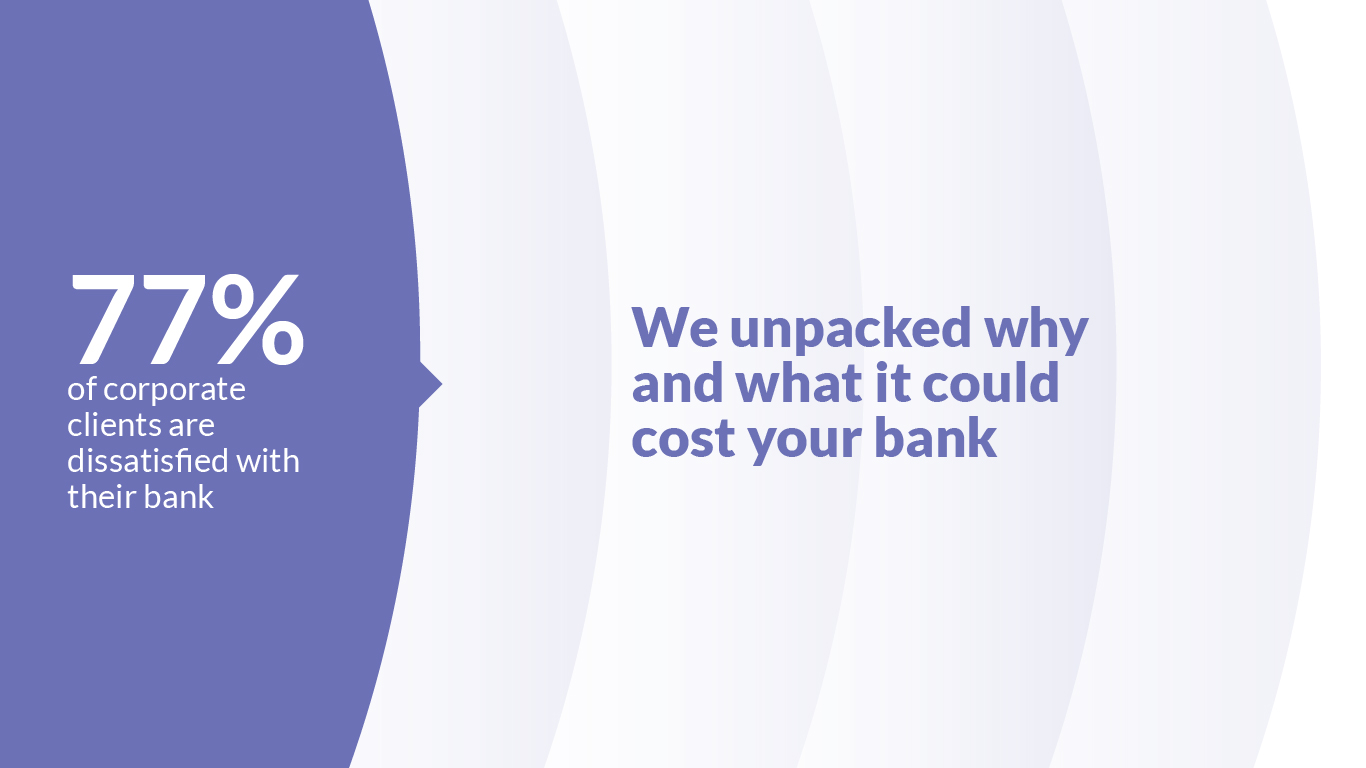
All of that is true. And none of it explains why only 23% of corporate clients worldwide believe their bank meets their needs completely.
That number, from Capgemini’s most recent research on corporate banking, is worth sitting with. Three in four corporate clients including treasurers, CFOs, and business owners are looking at their primary banking relationship and finding it wanting. Not because the bank failed to process their transactions. Not because the controls broke down. But because the experience of banking, the actual day-to-day reality of interacting with the systems and interfaces the bank provides, does not match what they need.
The same research found that 92% of corporate clients report limited integration between their bank and their internal systems including their ERP, their treasury platform, and their financial workflows. They are logging into a banking portal, extracting data, and manually reconciling it with the systems their business actually runs on. Every day and in 2026.
This is not a compliance failure. The bank passed every audit. This is an experience failure. And it has been hiding inside the compliance conversation for years.
The design choice that created the gap
Corporate banking was, for most of its institutional history, designed around the bank’s internal requirements. Approval workflows built for audit purposes. Reporting structures built for regulatory submissions. Access controls built for risk teams. The client, the corporate treasurer who needs to approve a payment at 11pm from a mobile device, or the SME owner who wants to understand their cash position before a board meeting, was considered a secondary user of a system built for other purposes.
This was not negligence. It was prioritization. The cost of a compliance failure in corporate banking is existential. The cost of a poor client experience was, for a long time, invisible, absorbed into relationship management, managed through dedicated RMs, and never quite visible on a balance sheet. That calculation has changed.
What corporate clients are doing about it
The response from corporate clients has been quiet but consistent. They are not switching banks in large numbers. The switching costs in corporate banking are real and significant. What they are doing is fragmenting. They are keeping their primary banking relationship for the transactions that require it, and building an ecosystem of fintech providers, payment platforms, and treasury tools around it that actually match how their business operates.
The bank remains. But it is no longer at the centre of the corporate client’s financial operation. It has been relegated to a utility, present, functional, and rarely thought about.
This is the risk that most corporate banking leaders are not measuring. Not attrition. Relevance.
What experience means in corporate banking
The experience gap in corporate banking is not about making things more attractive. It is about making them work the way a business actually works.
A corporate treasurer managing payments across multiple entities does not need a better-looking portal. They need their bank to connect directly to the ERP they already use, so payments route, approvals trigger, and reconciliation happens without manual intervention. That is API-connected banking. It is not a nice-to-have. Corporate clients increasingly demand self-service capabilities, flexible access to platforms for managing cash and liquidity, and real-time visibility into financial positions. Streamlined connectivity options such as host-to-host integrations and Treasury APIs are becoming the norm.
An SME owner managing a business banking account does not need a more comprehensive product menu. They need onboarding that takes hours instead of weeks, salary processing that works from a mobile device, and a collections experience built around how their business collects money. That is SME-in-a-box thinking. Built for the business, not around the bank’s product architecture.
A relationship manager covering a portfolio of corporate clients does not need a thicker compliance manual. They need a system that shows them which client is approaching a critical moment, a payment threshold, a credit facility review, a cash flow inflection, before the client must call them about it. That is data-led relationship management. And it requires a platform that connects client behaviour, transaction data, and account activity into something the RM can use.
The banks closing the gap
The institutions making progress on this are not the ones that have decided compliance matters less. They are the ones that have stopped treating compliance and experience as a trade-off.
The architecture that enables this is an omnichannel corporate banking platform, one that brings the controls, the approval workflows, and the audit trails that compliance requires, and wraps them in an interface, an API layer, and a data model that matches how businesses operate.
Bandhan Bank’s deployment of a corporate and SME banking platform is an instructive example. The bank needed to serve a growing base of SME clients whose banking needs, payroll, collections, working capital, credit, were not being met by generic corporate banking products. The result was a 30% growth in SME customer base after deployment. Not because the bank relaxed its controls. Because it built a product that actually fit the client.
The conversation that needs to happen
The question corporate banking leaders need to be asking is not whether their controls are adequate. They almost certainly are. The question is whether the clients who rely on those controls every day find them functional or find them in the way.
Accenture reports that most institutions have achieved functional digital efficiency, but these channels are often described as functionally correct, but emotionally devoid. In corporate banking, that gap between functional and meaningful is where client relationships quietly thin out.
The industry built corporate banking for compliance. That was the right priority for the right moment.
The client has been patient but they are running out of it.
Sources
-
Capgemini World Corporate Banking Research
23% client satisfaction rate; 92% integration gap between banks and corporate client systems
https://www.capgemini.com/insights/research-library/world-corporate-and-investment-banking-report/
-
TreasuryUp: Online Commercial Banking 2025 Trends
Host-to-host integrations, Treasury APIs, real-time visibility as corporate client expectations
https://treasurup.com/trends-developments-online-commercial-banking-2025/
-
Accenture / Unblu: Customer Experience Trends in Banking 2026
Digital channels described as functionally correct, but emotionally devoid
https://www.unblu.com/en/blog/customer-experience-trends-in-banking
-
Clayfin Technologies: Bandhan Bank Deployment
30% growth in SME customer base after Clayfin corporate banking platform deployment