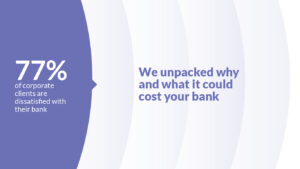

For long, SME banking has been ‘bundled’ into ‘Corporate Banking’ or ‘Retail Banking’, thanks largely to the market perceiving SMEs as a lower-margin, higher-effort segment. The documentation burden is real, and the credit risk is harder to assess than it is for a large corporation with audited financials.
No wonder, the abandonment rates during digital SME account origination exceed 50% at the banks that offer it, and 49% of small businesses say they want more sophisticated banking capabilities than their primary institution currently provides.
Deloitte’s own research on the segment is specific about how small and micro businesses are “a largely underserved segment that’s lost between retail and commercial bank offerings.” Not necessarily overlooked but often caught between two products, neither of which was built with them in mind.
The two extreme design choices that SME Banking has endured
Retail banking is built around an individual managing their own money. Transaction rarely involves anything more than a login, a simple transaction or historical statements. Banking life for an SME entity is entirely different. Owners, founders, management, and bookkeepers all need access to the same account with different levels of permission. Payroll has to run for a small team with no errors or without complexity. None of these needs are central to the retail banking platform’s design.
Corporate banking solves the opposite problem badly. It’s built for treasury departments, multi-entity structures, and approval chains that assume a dedicated finance function exists to manage them. An SME onboarded into a Corporate Banking platform ends up inheriting the complexity sized for a business ten times its own scale. Functionality feels invariably overengineered, while the things it actually needs like fast onboarding, credit tied to its real cash flow, a way to collect payments that matches how its own customers actually pay, still go unaddressed.
Banks have spent years treating SMEs as either a smaller corporate client or a more complicated retail one. In practice, they are neither, and the two products built for those other segments are never going to fit.
The cost borne by the SME
The consequence of this friction shows up almost immediately. For example, SMEs increasingly rely on real-time payment adoption to manage cash flow, and yet a report by Aite-Novarica reveals only 25% of SMEs manage to avail the benefit of the functionality. Nineteen percent of small businesses, and 27% of those run by millennials and Gen Z, say they’re actively considering switching their primary bank within two years because the product never matched how their business actually runs day to day. This clearly exposes a product built for someone else’s business, handed to an SME anyway, and quietly revealed to have failed its customers in the numbers.
What a product built exclusively for the segment can actually look like
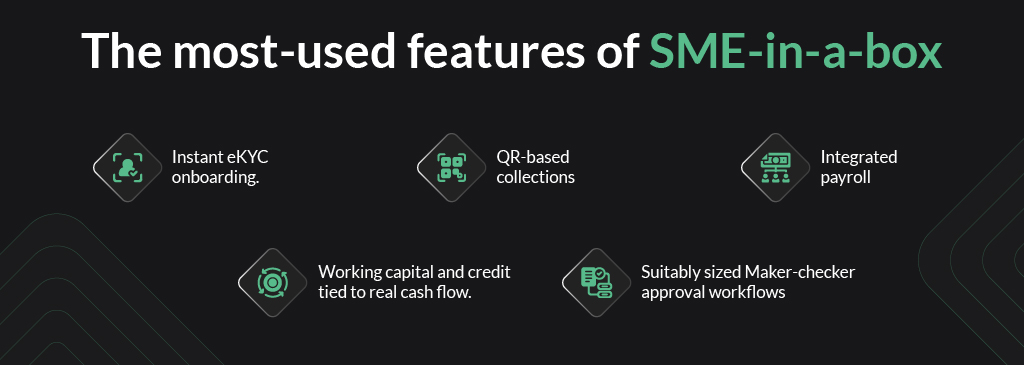
Clayfin’s design of its “SME-in-a-box” banking product centers itself on how an SME actually operates. A peek into the most-used features reveals how SMEs lap up value that’s relevant to their business.
Bandhan Bank’s SME banking transformation, built on Clayfin’s platform, provides clear evidence of what changes when a bank stops adapting an existing product and starts building for the segment directly. The result was a verified 38% growth in its SME customer base. Because the product finally matched the business, it was meant to serve.
Sources:
- Deloitte, Small Business Banking Needs (2022 survey of 500+ US small and micro businesses)
- SAP Fioneer, citing Aite-Novarica and Cornerstone Advisors research, North American SMEs Still Don’t Have the Digital Banking They Need
- Industry analysis on SME banking segmentation and product-market mismatch, 2026
- Clayfin Technologies, Bandhan Bank SME banking deployment results