

Instant payments are no longer an emerging capability in the GCC. They are fast becoming the default expectation. Qatar’s experience over the past year makes this shift especially clear, offering a glimpse into where regional payment infrastructure is heading and what banks must prepare for next.
A Noticeable Shift in How Banks Operate
As real-time payments scale, the change banks experience is often gradual rather than disruptive. Systems begin to surface information faster, decisions are made closer to the moment of activity, and dependencies on end-of-day cycles reduce over time.
This shift does not demand dramatic organisational change. Instead, it rewards platforms that can support continuous processing consistently. Where platforms are aligned to this mode of operation, real-time payments feel like a natural extension of existing services rather than a separate capability.
Qatar’s Instant Payments Moment
Qatar’s real-time payment network, Fawran, has moved from adoption to scale. As of October 2025, instant payments account for 24 percent of all payment transactions, growing at 21 percent month on month. This is not marginal growth. It signals a fundamental change in how money moves across the financial system.
The direction is reinforced by the Qatar Central Bank, which continues to modernise the country’s payments infrastructure and expand the scope of instant payments. What started with person-to-person transfers has now extended into broader use cases, including business transactions.
For banks across the GCC, this is an early indicator rather than an exception.
What Real-Time Payments Now Demand from Banks
The growth of instant payment systems brings with it a new baseline for banking platforms. Supporting real-time payments is no longer about enabling faster transfers alone. Banks are now expected to deliver:
- Instant settlement, without end-of-day batching or delayed reconciliation
- Alias-based routing, where customers transact using identifiers such as mobile numbers or IDs rather than account details
- 24/7 availability, including nights, weekends, and holidays
- High resilience, with minimal tolerance for downtime or latency
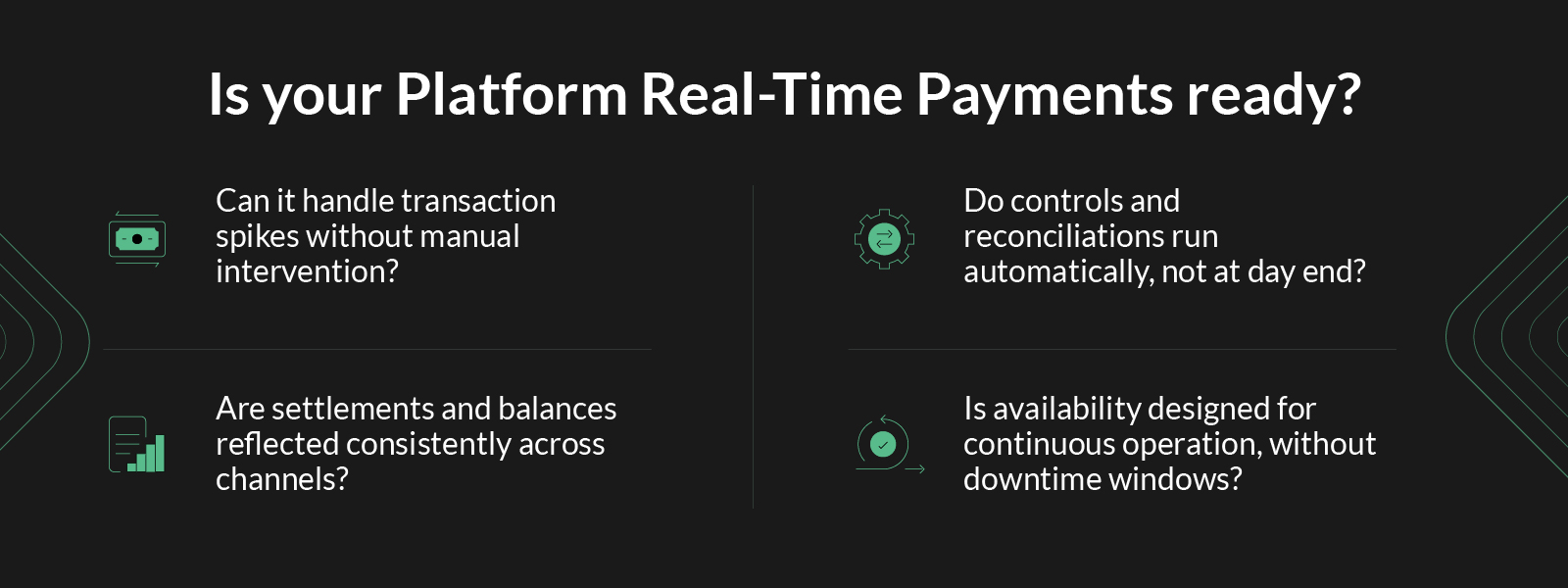
These requirements place significant pressure on existing systems. Platforms designed around batch processing, limited operating windows, or fragmented data flows struggle to meet the operational intensity of real-time payments at scale.
Can Legacy Infrastructure Become a Constraint?
Many banks across the GCC still operate with architectures built for a different payments era. In such environments:
- Settlement and reconciliation are often decoupled from transaction execution
- Payment channels rely on multiple intermediary systems
- Availability is aligned to business hours rather than continuous operation
When instant payment volumes rise, these limitations become more visible. The challenge is not just speed, but consistency, reliability, and the ability to scale without manual intervention. As corporate payments move onto instant rails, the tolerance for failure becomes even lower.
How a Modern Banking Platform Helps
This is where a modern digital banking platform becomes essential. One that sits intelligently above the core, enabling banks to deliver real-time customer experiences without rewriting foundational systems.
Clayfin’s digital banking platform focuses on unifying customer journeys, insights, and integrations across retail and corporate channels. With modular architecture and API-driven deployment, it helps banks modernise digital touchpoints, personalise engagement, and scale new capabilities while continuing to rely on their existing core infrastructure.
Looking Ahead
Qatar’s instant payments trajectory is unlikely to remain an isolated case. Across the GCC, real-time payment systems are expanding in scope, volume, and strategic importance. Banks that invest early in platforms capable of supporting continuous settlement, rich messaging, and round-the-clock availability will be better positioned for the next phase of regional payments modernisation.
The question is no longer whether instant payments will dominate, but whether existing banking platforms are ready to sustain them.